 Login
LoginHidden in Plain Sight: Tackling Crime on the UK’s High Streets

Organised crime is operating in plain sight on Britain’s high streets – fuelling wider criminal networks and putting consumers at serious risk.
CTSI, in partnership with the Anti-Counterfeiting Group, have published a report – Hidden in Plain Sight: Tackling Crime on the UK’s High Streets – that exposes the true scale of this threat, revealing the growing pressure on Trading Standards professionals at the frontline, and the damage inflicted on individuals, communities, and the economy.
The rise of serious and organised crime in UK high street shops
Serious and organised crime (SOC) is estimated to cost the UK at least £47bn annually. But beyond the economic impact, criminality on our high streets also:
- undercuts legitimate businesses
- poses a risk to public health through unsafe products and underage sales
- deprives the Government of tax receipts that could help fund vital services
- impacts Trading Standards services by diverting resources away from competing priorities, including supporting law-abiding businesses
Despite targeted efforts to disrupt it, insufficient investment in enforcement agencies, problems surrounding enforcement powers, minimal deterrents for related offences, and the complicated operations of organised crime groups (OCGs) means SOC poses a serious threat to the UK economy, consumers, and businesses.
To effectively tackle this issue, significant and sustainable investment will be needed to empower enforcement agencies to take targeted, multi-partner action to clamp down on SOC in the UK. While Local Authority Trading Standards are not the lead agency to spearhead efforts to disrupt SOC, the profession’s unique powers and close links with the local community make it well placed to play an invaluable supporting role.
Mapping the UK's High Street Hot Spots
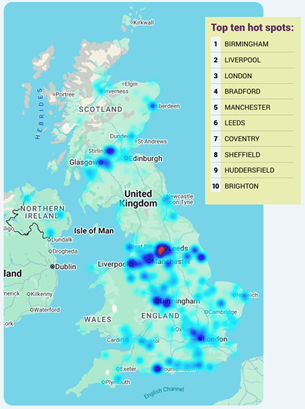
In a recent CTSI survey (2025), Trading Standards professionals were asked to identify perceived organised crime hot spots in their localities. This data, supplemented by data from the Anti-Counterfeiting Group, produced a snapshot hot spot map that highlights the nationwide extent of organised crime on UK high streets.
Understanding the hot spot map
- The snapshot “hot spot” map illustrates that the issue of OCGs operating out of high street shops is widespread.
- As may be expected, there are a large number of hot spots in the more populated cities and towns.
- However, there are also hot spots in less obvious locations – such as in Great Yarmouth, which may be linked to the tourist trade.
- The data also suggests the presence of two “corridors of crime”: One stretching horizontally from Liverpool on the west coast to Hull and Grimsby on the east coast and the second encompassing a collection of coastal settlements across Dorset, Hampshire, and Sussex
According to CTSI’s 2025 survey on the experiences of Trading Standards professionals:
- 96% said they had encountered SOC or OCGs within their duties
- 97% were aware of suspected OCGs operating out of retail premises on their local high street(s)
- In some areas, as many as half of mini-mart / convenience stores and vape shops, up to a third of American candy stores, and as many as one-in-four fast food takeaways have links with organised crime
- Almost three-quarters of Trading Standards professionals said that they had been physically assaulted, threatened with violence, or experienced intimidatory behaviour in the course of their duties
What are we calling for?
Our ten-point plan to reclaim the UK's high streets:
- Invest in Trading Standards and the wider enforcement landscape
- Support and encourage partnership working
- Optimise intelligence sharing
- Address eye-watering storage costs
- Increase Accredited Financial Investigator resource and POCA use
- Strengthen Closure Order powers
- Landlords – a carrot and stick approach
- Strengthen enforcement powers
- Empower our Ports and Borders
- Address consumer attitudes to illegal goods

